
Reassessing Late Medieval Pharmacology
Logical and Metaphysical Tools in the Medical Context
Supported by the European Research Council (ERC), ReMedY is a Starting Grant project led by Marilena Panarelli and hosted by the Department of Humanities at the University of Palermo.
The project investigates the logical, metaphysical, and semiotic foundations of late medieval Rational Pharmacology, the branch of medieval medicine concerned with classifying the properties, virtues, and operations of drugs.
During the later Middle Ages, the study of drugs underwent a profound transformation. As Aristotelian philosophy became increasingly integrated into medical learning at European universities, Rational Pharmacology developed into a sophisticated theoretical framework.
The investigation of medicinal substances was no longer limited to describing their therapeutic effects, but also involved fundamental questions about how drugs should be classified, how their properties could be explained, and how to establish reliable pharmacological knowledge.
Our Research Question
Which logical and metaphysical assumptions shaped the classificatory system developed in late medieval Rational Pharmacology?
Our Interconnected Strands
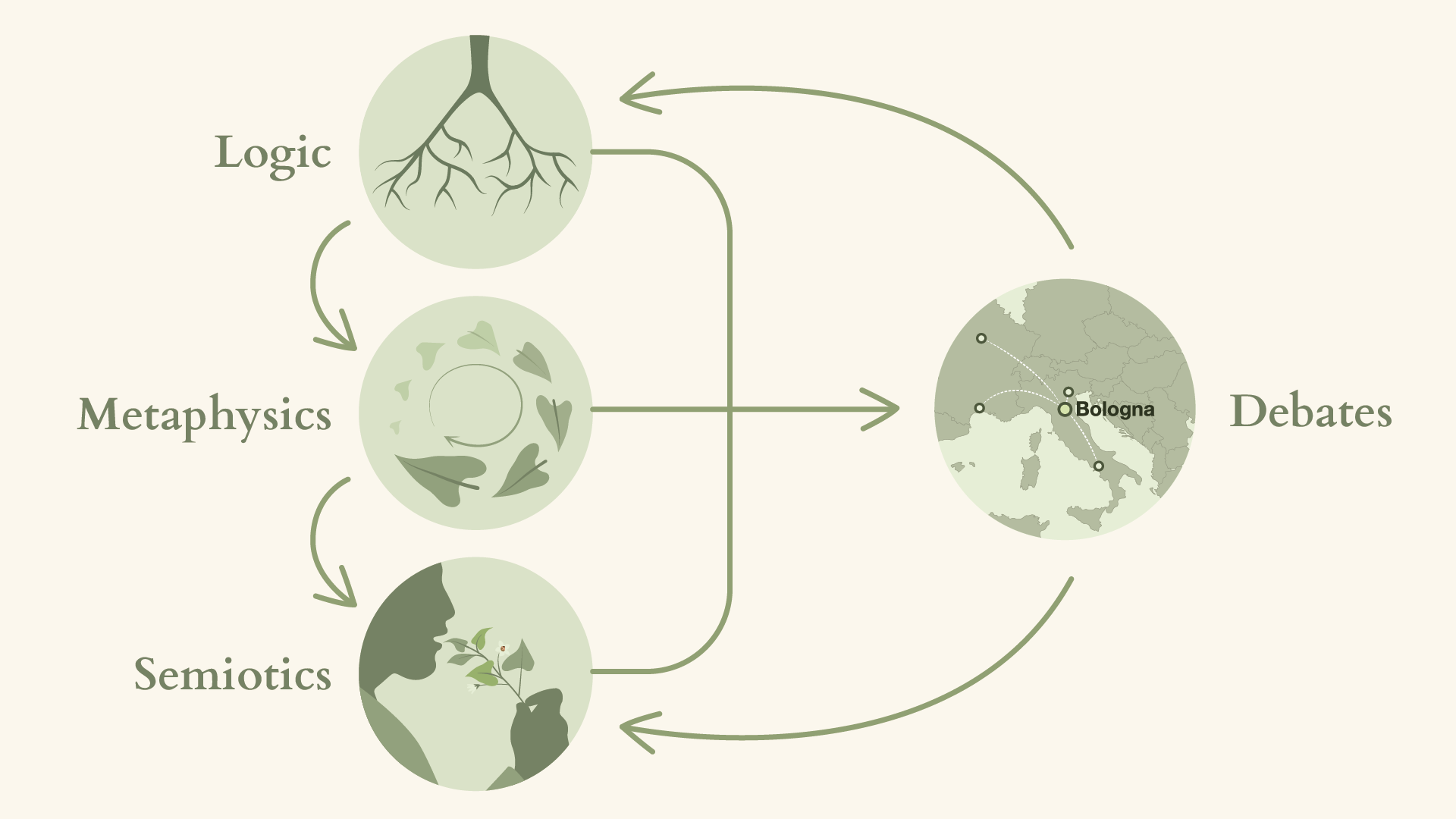
Logic
Reassessing the application of logical theories to medieval pharmacological classifications and the principles used to organise the properties of drugs.
Metaphysics
Investigating the philosophical foundations of the properties, effects, and operations of drugs, by focusing on the metaphysical principles underlying the medicinal virtues.
Semiotics
Reconstructing the pharmacological classification of signs by examining how sensory features, e.g., taste, smell, and colour, were interpreted through rational and experience-based procedures as indicators of a drug’s qualities.
Medical Debates
Exploring how medical scholasticism transformed Rational Pharmacology and tracing the philosophical debates that shaped its development across medieval European universities, from Bologna to Paris.
Our Hypothesis and Epistemic Framework
ReMedY hypothesises that a distinct tradition of Rational Pharmacology emerged in fourteenth-century Bologna, where pharmacological classifications became a privileged field for applying and refining logical and metaphysical theories.
This interaction between philosophy and medicine contributed to the development of new conceptual tools, terminology, and ways of understanding pharmacological knowledge.
By combining philological, editorial, historical and epistemological approaches with the history of medicine, pharmacology, logic, metaphysics, and semiotics, ReMedY offers the first systematic reconstruction of the philosophical foundations of late medieval Rational Pharmacology.
The project investigates pharmacological texts from different geographical areas, bringing to light previously unedited sources through critical and digital editions, as well as doctrinal studies.
In doing so, the ReMedY project provides new insights into how philosophical theories shaped medieval medicine and the development of scientific knowledge.